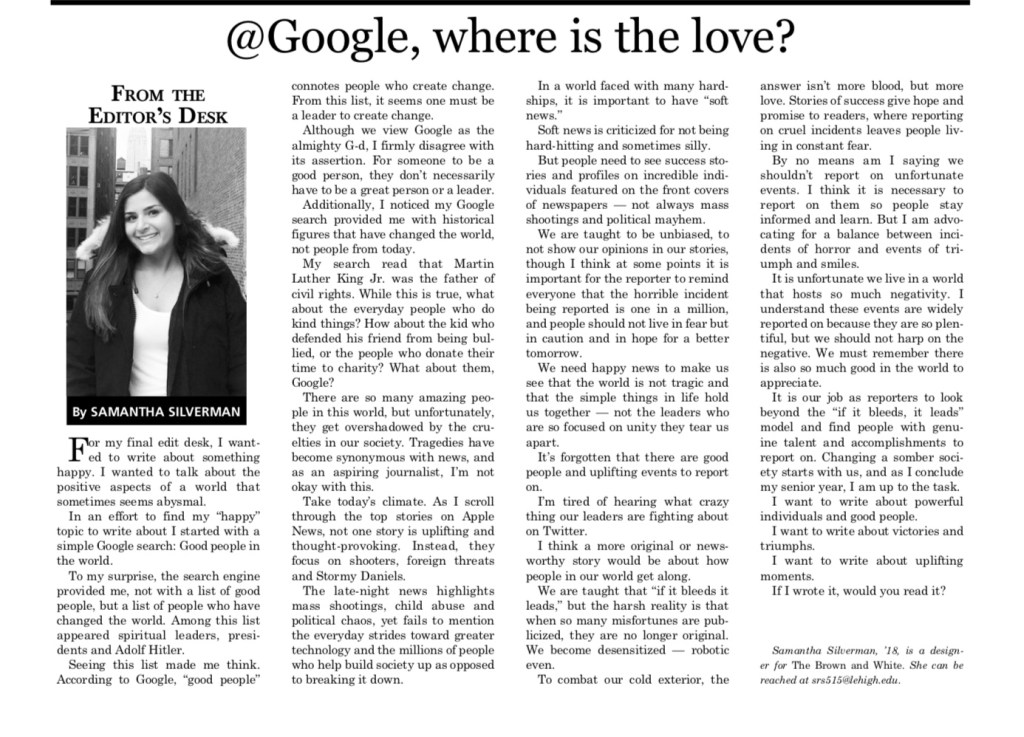
With all the unrest in digital journalism right now in the wake of AI, I found myself updating my LinkedIn and resume yet again. In doing so, I came across an opinion piece I wrote in 2018 for my college newspaper, The Lehigh Brown & White, titled: ‘@Google, where is the love?’
Now, as an experienced editor, here I am asking the same question again.
As a naive journalism major who thought writers just wrote for the soul without a strategy, I discussed how Google and the news industry at large focused on covering tragedies, mass unrest, and notable figures (good or evil, but mainly evil.) While it’s important to cover the latest news, which sadly tends to be tragic due to the nature of our society, I stressed the importance of covering stories of triumph from the average and uplifting content to add light to a world with so much darkness.
It looks like Little Sam was wise beyond her years.
Never did I imagine that I would make a career for myself answering to the all-mighty Google. As a reporter, I was consistently asked if my pitches had search value. As an SEO editor, I constantly looked to Google for the latest trends and learned to analyze story performance to gauge how to tickle Google’s fancy from topics, word choice, and more. I’d see a trending query, assign it to a reporter, and the page views would roll in as predicted.
But suddenly my relationship with Google became contentious. The formula I was taught and replicated time and time again began to fail. Pieces that should have thrived based on current trends and topic authority began to fall flat. The math wasn’t mathing, as they say.
In the wake of algorithm changes and the implementation of AI, I looked to the data to get back in Google’s good graces. The content that saw the most success? Stories of average people who rose to the top. Pieces that were uplifting, original, and uniquely empathetic in a way that AI could never be. Sound familiar?
At age 22 I wrote: “I’m tired of hearing what crazy thing our leaders are fighting about on Twitter. I think a more original or newsworthy story would be about how people in our world get along.”
Now at age 28, after years of a complicated relationship with Google, it looks like the platform finally read my plea.
While Google is promoting content that inspires and is weeding out pieces that AI can handle to better serve its users, the changes have turned newsrooms upside down.
With fewer page views comes mass layoffs. But what the industry has yet to realize is that there is still a place for journalism in the wake of AI, maybe now more than ever, and it will need journalists who understand that.
In times like this, I think about Little Sam. She was passionate about journalism, had big dreams, and didn’t consider failure an option. I may be older and wiser, but here I am yet again asking ‘@Google, where is the love?’ with a slight edit:
@themedia, where is the love?
 Sam Silverman Says
Leave a comment